

My friend Lydon asked me a simple question: "Remember that Warhammer 40k Conquest game?"
We started playing it during, or right after, COVID. We picked it on purpose. Neither of us wanted to chase rare cards, and the Living Card Game format gave us that deckbuilding feel without the money sink of Magic or Pokémon. Every box has the same cards in it. You buy the box, you have the cards.
So I said sure, went into my 20-foot storage unit of board games, and found the boxes that had been gathering dust for the last six years. Me being me, I then looked on eBay and realized I could buy the remaining expansion cards — everything that came out after we stopped playing — for around fifty dollars.
So I got the new (very old) cards. Now I have Tyranids and Necrons. And I realized I don't remember how to build a deck.
It's intimidating. You have a stack of a hundred or so cards for one faction and no memory of what the strategy is for building something playable. I don't care about winning a tournament. But as usual, I want to play well, and I want to help Lydon build a deck and play well too.
So here's the thinking, in the order I'd do it.
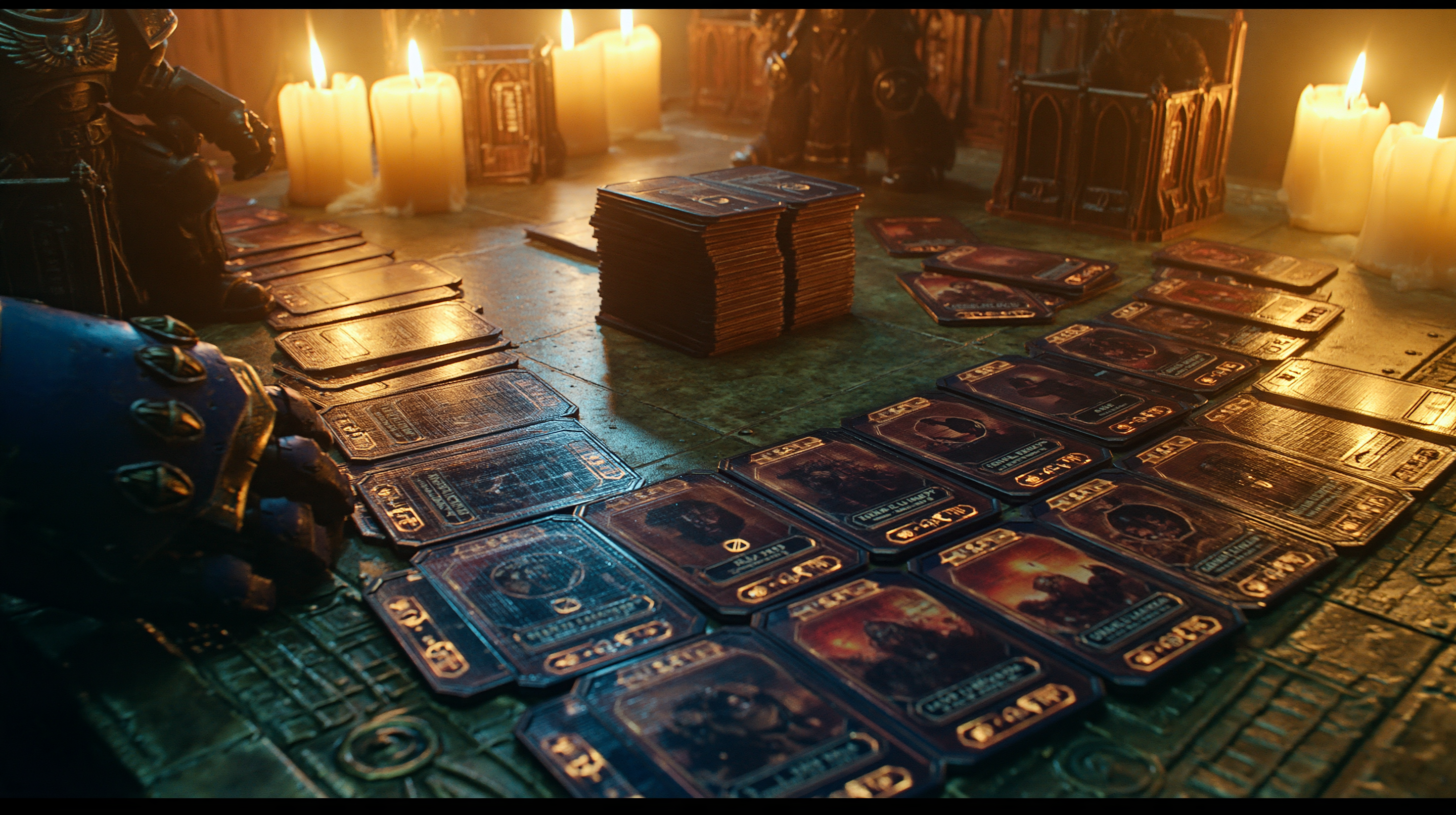
Pick your warlord first
Your warlord is the one card you're guaranteed to have every single game. It also picks your faction for you, and it drags eight more cards into the deck with it: its signature squad, which is mandatory.
So before you look at anything else, look at your warlords and ask what each one is good at. Some want to grind out long battles. Some want to be everywhere at once during the command phase. Some barely want to fight at all. If you don't know yet, pick one that doesn't commit you to much and learn from it.
Choose an ally that props up a strength or covers a weakness
Most factions can borrow cards from one of their two neighbors on the alignment wheel, and only cards without the loyal or signature icon. Space Marines can reach for the Astra Militarum or the Tau, but never both, and never the Orks.
I'm going to be honest: I'm horrible at this part. I'm much more prone to building mono-faction. But the right way to think about it is to ask what your warlord is bad at, then go shopping in the neighbor that fixes it. Short on command? Find units with command icons. Need a better engine? Look next door. It helps to think in specific cards: "would I rather have these three Space Marine cards or those two Eldar ones?" is a much easier question than "Space Marines or Eldar?"
(The two late arrivals break this step. Tyranids ally with no one and pick a synapse unit instead. Necrons don't ally at all; they spin an enslavement dial and can pull in common units from almost anywhere. More on those another time.)
If you love a particular warlord and ally pairing, tell me in the comments. I genuinely want to hear it, because this is where my decks are weakest.
Decide your ratio before you pick a single card
This is the step people skip, not intentionally, but because they might not even know it's the foundation of building a deck.
Before you pull cards, decide how many of each type you want. You're controlling the odds of what shows up in your first hand. Too many events and you have nothing to deploy; not enough events and you have no tricks and no shields.
You don't have to invent the numbers yourself. Back in 2015, a player named Kingsley wrote a deckbuilding piece for CardGameDB (the site is gone, but the Wayback Machine kept it) with a baseline I still think is the sanest place to start:
- About 30 units, mostly cheap. Eight or nine that cost 1, around a dozen that cost 2, about six at 3, two or three at 4, and no more than one or two big expensive ones.
- About 13 events, around 4 attachments, and 2 or 3 supports.
- At least 15 cards with shield icons, with five or six of those carrying two shields. Supports have no shields, which is why you run so few of them.
Then he draws test hands before playing a real game. His "rule of four": with a normal seven-card, seven-resource warlord, a decent opening hand lets you make at least four plays and puts at least four command icons on the table.
Even the comments under his article argued that 30 units was on the high side, and one player admitted his first decks ran 32 to 35 units and drowned. That tells you the real lesson. Pick a ratio, then keep it.
Pull cards up to your numbers. Then resist.
Once you know how many of each type you want, go through your pile and pull out no more than that.
You're going to want more. That cool event. That amazing support card. Resist. You only draw so many cards in a game: your opening hand, two more each round, and a few from winning command struggles. Every extra card you can't stand to cut makes it a little less likely you'll draw the ones you need. Having cards you won't draw anyway, and not reliably getting the ones you want, is a waste.
My confession
I'm the worst person to give the advice above.
My worst habit is falling completely in love with a clever gambit and trying to build the whole deck around it. I'd rather lose three times in a row chasing a combo the card pool doesn't really support, one I can only pull off once in a blue moon, for the satisfaction of people at the table going "Wait, what is happening now? How did you do that?" Even if I still lose that game, in my heart, I won.
I really believed, in some cases, that another war pack would come out with a few more cards that would make the strategy possible. In some cases one did. Most of the time it didn't. It was just a random idea that was fun, and if you can't reliably draw the cards, it isn't a viable strategy.
Thread the needle
There are hyper-optimized decks out there. It's an LCG; you can copy any deck that has ever won any tournament, card for card.
So thread the needle between gimmicky "I want every character from my favorite Warhammer 40k novel" and the most boring, technically perfect deck there is. It's not fun to watch your favorite characters get demolished turn after turn while you hope for an impossible combination. But it's also not fun to play down cards with the right numbers to win if you don't care about the flavor of the cards.
Build the deck that shows up. Then give yourself room for one gambit you believe in.
There is a reason we're playing a strongly thematic board game instead of poker or bridge, and it's not for the highest numbers in a hand.
